Order form vs invoice

Alex Shi

An order form is the executable contract that sets pricing, seats, term, and billing rules for a specific deal, and it is what triggers provisioning once signed. An invoice is the financial request that follows, generated strictly under the terms the order form already locked in. If the two disagree, the order form controls, because it is the contract; the invoice is just the bill that contract produces.
TL;DR:
- A signed order form is the primary contract controlling commercial terms like price, scope, and schedule, while the invoice only requests payment based on those terms.
- To prevent billing disputes, order forms should include clear deal identifiers, pricing structures, billing schedule, references to governing documents, and precedence language.
- Most discrepancies arise from mismatches in billing frequency, missing one-time fees, or absent purchase order numbers, which can be mitigated with structured, automated order forms.
- Key legal clauses like the order-of-precedence and clear PO requirements help avoid disputes and ensure invoices match the agreed-upon terms.
- Automating order form creation, signing, and integration with billing systems reduces manual errors and minimizes the risk of invoice rejection or disputes.
Table of Contents
- Order form vs invoice: a quick side-by-side
- What fields belong on a SaaS order form?
- How should order forms map to invoices and subscription records?
- What legal clauses protect an order form from disputes?
- How do you operationalize order forms at scale?
- Why most billing disputes are order form problems in disguise
- How Formable keeps your order forms invoice-ready
- Sources
- FAQ
Order form vs invoice: a quick side-by-side
The confusion between these two documents usually comes down to timing and authority. One is signed before work starts and creates legal obligations. The other shows up after, asking someone to pay for what was already agreed.
- Purpose and legal effect: The order form is a binding agreement, typically countersigned by both parties and incorporated under a master service agreement. The invoice has no independent legal force; it just requests payment under terms someone already accepted.
- When each is created, and who owns it: Sales or deal desk drafts the order form during closing, often with legal review. Finance or a billing system generates the invoice afterward, usually automatically, based on the order form's schedule.
- What each must include: An order form needs pricing, term, scope, and signatures. An invoice needs the amount due, the billing period, tax details, and often a PO number to clear accounts payable.
- How to audit your own documents: Pull five recent order forms and check whether the resulting invoices matched the stated billing frequency, one-time fees, and payment terms without a manual fix.
Below $5,000 in annual contract value, many SaaS companies skip the signed order form entirely and rely on click-through terms and an order confirmation. Once a deal involves negotiated pricing, custom terms, or procurement review, that shortcut no longer works, and you need a real signed agreement.
What fields belong on a SaaS order form?
A well-built order form does one job: it gives finance everything needed to invoice correctly without asking sales a follow-up question. Skimpy order forms are the number one cause of billing disputes six months into a contract, long after the person who closed the deal has moved on to the next one.
Here is what a complete order form should capture:
- Deal identifiers. Product or plan name, seat count or usage metric, contract start date, and term length.
- Pricing structure. Whether charges are recurring or one-time, any discounts applied, and how prorations are calculated for mid-cycle changes.
- Billing schedule and payment terms. Advance or arrears billing, invoice frequency, and net terms often allow about one to three months for payment.
- References to governing documents. Explicit pointers to the MSA, DPA, or SLA, plus a clear signature block for both parties.
- Precedence language. A stated rule for what happens when the order form and the MSA disagree on a commercial point.
Annual prepayment discounts of roughly 10 to 20% are common practice on SaaS order forms, but that discount only works cleanly if the order form also states, in the same breath, whether the invoice goes out in advance or arrears. Leaving that detail implicit is how a customer ends up disputing a bill they technically already agreed to pay.
Pro Tip: Put the precedence clause directly above the signature block, not buried in an exhibit. Whoever signs should see, in the same glance, which document wins if the order form and MSA conflict.
How should order forms map to invoices and subscription records?
The signed order form is the source of truth. Not the CRM opportunity, not the Slack thread where the discount got approved, and not whatever the account executive remembers telling the customer. If your billing system and your order form ever disagree, the order form should win, and your systems should be built to make that the default outcome rather than a manual reconciliation exercise.
Three mismatches account for most billing disputes:
- Billing frequency drift. The order form says quarterly, the subscription record defaults to monthly, and nobody notices until the customer flags four extra invoices.
- Missing one-time fees. Implementation or onboarding charges get verbally agreed but never written into the order form, so they never make it into the invoicing system at all.
- PO handling gaps. The customer's accounts payable team requires a purchase order number, but the order form was signed without one, and the invoice bounces before it ever reaches a human.
Enterprise accounts payable teams frequently reject invoices automatically when a valid PO number is missing, which stalls collection for weeks while someone chases down the right internal approver. The fix is structural: capture PO requirements as a required field on the order form template itself, not as a follow-up email after signature. Order forms that exist only as signed PDFs, disconnected from any structured record, are the root cause of most of these gaps, because the subscription system and the actual contract quietly drift apart over time.
What legal clauses protect an order form from disputes?
Legal risk on order forms rarely comes from exotic clauses. It comes from ordinary ambiguity that nobody catches until a renewal goes sideways or finance can't explain a charge to an auditor.
The order-of-precedence clause is the single most important safeguard. A workable version states plainly that for commercial terms like pricing, scope, and term length, the signed order form controls, while the MSA governs legal boilerplate such as liability caps and IP ownership. Without that split spelled out, a conflict between the two documents becomes a judgment call, and judgment calls are expensive to litigate.
Incorporation by reference deserves its own scrutiny too. If your order form says it's "subject to the terms of the MSA" without naming which version, or without attaching it, you've created a document nobody can actually enforce with confidence.
Watch for these during redlines:
- Auto-renew terms without a clear notice window, which trap customers into renewals they meant to cancel.
- Indexation clauses that let pricing escalate on renewal without a stated cap.
- Late payment remedies that are vague enough to be unenforceable, or aggressive enough to scare off procurement.
| Clause | Risk if missing | Fix |
|---|---|---|
| Order-of-precedence | Commercial terms conflict with MSA boilerplate | State order form controls on pricing, scope, term |
| Incorporation by reference | MSA version is ambiguous or unattached | Name the exact MSA version and attach or link it |
| Auto-renew notice | Customer renews without meaning to | Fixed notice window (typical notice periods vary widely) |
| PO requirement | Invoice gets auto-rejected by AP | Capture PO number as a required field pre-signature |
Giving the buyer a clear view of renewal mechanics, including auto-renew status and any indexation, lets their finance team forecast and your own team avoid a surprise cancellation at the worst possible moment.
How do you operationalize order forms at scale?
Once you're closing more than a handful of deals a month, ad hoc order forms become a liability. The fix isn't more legal review. It's structure, applied before the negotiation starts.
- Template the order form, and treat the MSA as fixed inventory. Build one reusable MSA and pair it with a one-page order form that only changes on the deal-specific fields.
- Capture PO and invoicing preferences before anyone signs. Ask procurement contacts for PO requirements and preferred invoice format during the negotiation, not after.
- Push signed data into your billing system directly. Structured templates and e-signing APIs turn a signed order form into machine-readable fields your subscription system can ingest without manual re-entry.
- Use redlining and playbooks to cut negotiation cycles. A pre-approved playbook tells your legal team which clauses can bend and which can't, so a Tuesday redline doesn't turn into a two-week email chain.
Pro Tip: If your order forms still get retyped into your billing tool by a human, that's your biggest source of invoice disputes, not your contract language.
Why most billing disputes are order form problems in disguise
Teams love to blame the MSA when a renewal goes wrong or a customer disputes an invoice. In most cases I've seen argued out, the MSA was fine. The order form was vague, or it was signed as a one-off PDF that never made it into any structured system.
That gap between sales promises and finance reality is where trust erodes fastest. A customer who negotiated a specific proration deal, verbally confirmed by an account executive, expects that deal to show up on the invoice exactly as discussed. When it doesn't, the dispute isn't really about the invoice. It's about a contract that was never precise enough to survive contact with a billing system.
The fix isn't stricter legal review. It's treating the order form as operational infrastructure from the start: template, structured, and built to feed directly into the systems that depend on it.
— Alex
How Formable keeps your order forms invoice-ready
Formable is built for exactly this gap between a signed deal and a clean invoice. You draft order forms from templates that pair with a reusable MSA, so pricing, term, and billing fields stay structured instead of buried in freeform paragraphs. Redlining happens in one shared workspace, so negotiation cycles shrink instead of dragging through email threads.
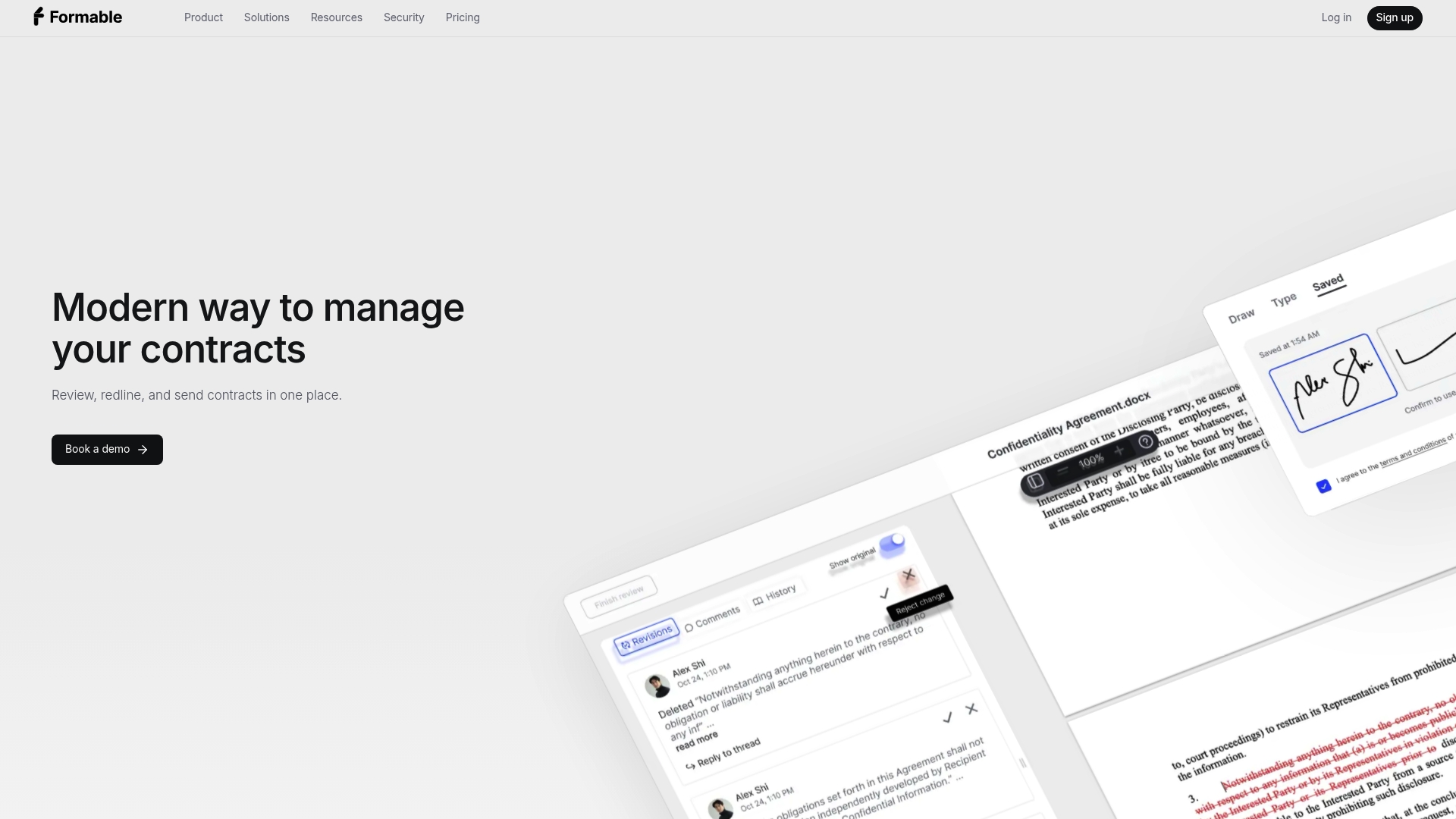
Formable's AI contract review flags missing precedence clauses, undefined PO requirements, and auto-renew terms without notice windows before anyone signs, catching the exact issues that turn into billing disputes months later. The embedded e-signing API captures signed order forms as structured data your billing system can actually read, not another PDF sitting in a shared drive.
If your order forms are still hand-built for every deal, start with a template you can reuse across your pipeline and see how much faster sign-to-revenue moves when the contract and the invoice finally agree.
Sources
- Your MSA isn't the problem — your order form is
- Purchase order vs invoice (blog)
- SaaS order form template: what to include
- No PO no pay policy
FAQ
What's the difference between an order form and an invoice?
An order form is a signed contract that sets pricing, term, and scope for a deal; an invoice is the payment request generated afterward under those already-agreed terms.
Is an order form the same as a purchase order?
No. A purchase order is a buyer-issued procurement document requesting goods or services, while an order form is the seller's contract capturing the commercial terms of a SaaS or services deal.
Does an order form replace a quote?
A quote is a non-binding price estimate; an order form becomes a binding agreement once both parties sign it, typically under an existing MSA.
What happens if the order form and MSA conflict?
A properly drafted order-of-precedence clause should state that the signed order form controls commercial terms like pricing and scope, while the MSA governs legal boilerplate such as liability and IP.
Why does my invoice keep getting rejected by the customer's AP team?
Missing purchase order numbers are a leading cause of automatic invoice rejection at enterprise accounts payable desks, so capture PO requirements on the order form before signature, not after.
Can Formable help convert a signed order form into billing data?
Yes. Formable's e-signing API and structured templates capture order form fields as machine-readable data your billing and provisioning systems can use directly, cutting the manual re-entry that causes invoice mismatches.